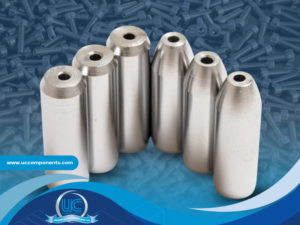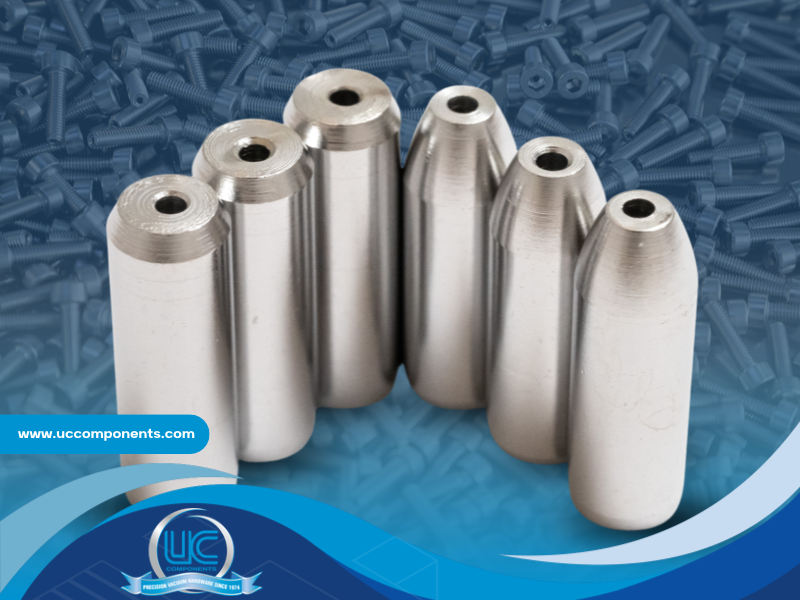
Selecting the right dowel pin involves more than matching diameter and length. Lead-in geometry plays a critical role in how components align during assembly, particularly in blind-hole applications and tight-tolerance environments. Understanding the differences between bullet nose and chamfered dowel pins can help engineers reduce insertion force, prevent bore damage, improve alignment accuracy, and achieve more consistent assembly results.
Bullet nose dowel pins use a radiused lead instead of a sharp chamfer, allowing the pin to ease into the mating bore rather than forcing initial contact at an edge. That small change in geometry has a noticeable impact during assembly. The radius reduces localized contact stress, lowers insertion force, and helps prevent scoring or edge damage in precision bores. More importantly, it allows the pin to naturally correct minor positional or angular errors as it starts to engage.
That self-centering behavior becomes especially valuable in blind-hole applications. When the pin and bore can’t be visually aligned, even slight misalignment can cause a chamfered pin to catch the bore edge. Operators feel this as a hard stop or “false seat,” and in automated systems, it often shows up as spiking insertion force or inconsistent seating. A bullet nose pin enters more gradually, guiding the components into concentricity before the full shank engages. The result is smoother insertion, less binding, and far more consistent assembly in tight-tolerance conditions.
In real-world operating environments, the benefits extend beyond ease of assembly. The gradual engagement reduces the risk of galling in hardened or precision-ground bores and helps protect brittle materials, such as ceramics or hardened tool steels, from chipping. Lower insertion forces also matter when dealing with thin-wall components or delicate features that can distort under load. In assemblies exposed to thermal cycling, the reduced tendency to bind during insertion and removal can significantly improve long-term reliability.
For these reasons, bullet-nose dowel pins are often specified in aerospace assemblies where precise alignment is required, but components must remain serviceable. They are common in semiconductor equipment, particularly in vacuum chambers and wafer-handling systems where blind holes are unavoidable, and particle generation must be minimized. Medical device fixtures benefit from the predictable insertion forces and reduced surface damage, supporting repeatability and cleanliness. Tooling plates and fixtures that are frequently reconfigured also have a longer service life when bullet-nose pins are used in alignment-critical locations.
That said, bullet nose geometry does not compensate for poor fundamentals. Problems still arise when hardness is underspecified for high-load tooling, when surface finish is inappropriate for cleanroom or vacuum use, or when tolerance classes are mismatched to the operating temperature range. One of the more common mistakes is assuming the bullet nose will “fix” a bad hole. Excessive taper, rough surface finish, or positional error in the bore will still compromise alignment accuracy and accelerate wear.
Tolerance selection remains a key factor in how well any dowel pin performs. The relationship between pin diameter, hole size, and material hardness determines whether the pin acts as a true locator or merely a loose guide. A bullet nose pin with a precision-ground shank only maintains concentricity when paired with a properly controlled bore. Too much clearance eliminates the alignment benefit altogether, while too little clearance increases insertion force and raises the risk of galling or seizure.
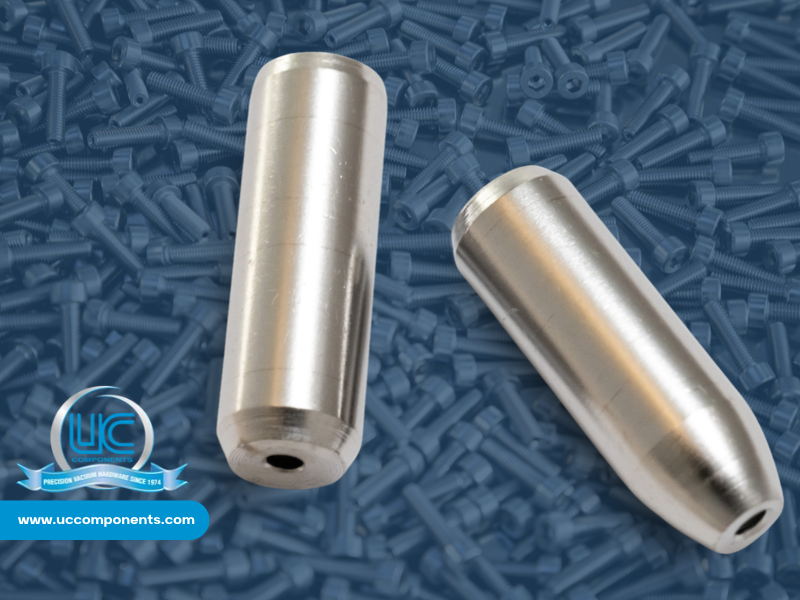
Chamfered dowel pins still have their place. In assemblies where other features and mating holes already control alignment, a chamfered pin provides adequate lead-in without introducing unnecessary compliance. These pins are often preferred in rigid tool-and-die setups where high clamping forces lock components into position, and alignment repeatability depends more on plate flatness and machining accuracy than on pin geometry.
In high-load tooling environments, material hardness becomes just as important as geometry. Tool-and-die assemblies are exposed to compressive loads, repeated impact, and abrasive wear. Hardened dowel pins resist brinelling and deformation, hold diameter through thermal cycling, and reduce fretting corrosion at steel-on-steel interfaces. Over time, this directly translates into better positional stability and longer fixture life.
Grooved dowel pins serve a different purpose altogether. By displacing material into longitudinal grooves during installation, they provide strong mechanical retention without adhesives. This makes them well-suited for vibration-prone assemblies, softer materials such as aluminum or plastics, and applications where field replacement is expected. Because the material flows into the groove reliefs, grooved pins can reduce the risk of excessive hoop stress compared to straight press-fit pins.
Selecting a dowel pin should be treated as an engineering decision, not a catalog checkbox. Bullet nose pins excel in blind holes and misalignment-sensitive assemblies. Chamfered pins work well in rigid, guided systems. Hardened pins extend life in high-load tooling, and grooved pins offer secure retention where press fits alone fall short.
UC Components, Inc. provides dowel pins designed with these real-world constraints in mind. Matching geometry, material, hardness, and tolerance to the application has a direct impact on alignment accuracy, assembly consistency, and long-term reliability across aerospace, medical, semiconductor, and tooling environments.
At a glance: Bullet Nose vs. Chamfered Dowel Pins
| Bullet Nose | Chamfered Dowel Pins |
| Actively help align components during insertion. The radiused lead guides the pin into the bore, correcting minor positional or angular misalignment as engagement begins. | Assume the parts are already aligned. The chamfer only eases entry and does not provide any self-centering behavior. |
| Better suited for blind holes, limited-visibility assembly, and automated or repeatable processes where alignment by feel or motion is required. | Perform best in open, rigid assemblies where mating features already control alignment. |
| Reduce insertion force, minimize edge damage, and lower the risk of galling or binding, especially in tight-tolerance or thermally cycled assemblies. | Can exhibit higher insertion force and edge contact if even slight misalignment is present. |
| Commonly used in aerospace, semiconductor, and medical fixtures where alignment accuracy and surface protection are critical. | Remain standard in many tool-and-die and heavy fixture applications with high clamping forces and controlled setup. |
Bottom line: choose bullet nose when alignment must be achieved during insertion; choose chamfered when alignment is already controlled by the assembly.
Why choose vented fasteners from UC Components for clean-critical applications?
UC’s RediVac® fasteners have been instrumental in vacuum and other clean-critical applications since 1974. We offer a wide variety of fasteners and O-rings, including, but not limited to, standard and vented screws, washers, and hex nuts in multiple materials. We offer numerous finish options, specialized venting designs, complete custom product development, and ISO Class 5 Cleanroom cleaning & packaging.
View our parts catalog online to find the components you need, request a quote, or contact us for more assistance or additional information. If you do not see the fastener, material, or O-ring that you need listed in our standard products, please give us a call! We may not stock it, but we are happy to acquire or manufacture just about any fastener or O-ring you need. A live Certified Fastener Specialist is waiting to hear from you and will help you find the perfect part and finish. From student to scientist, no UC customer is ever too small – and no job is too big! Contact UC Components today.